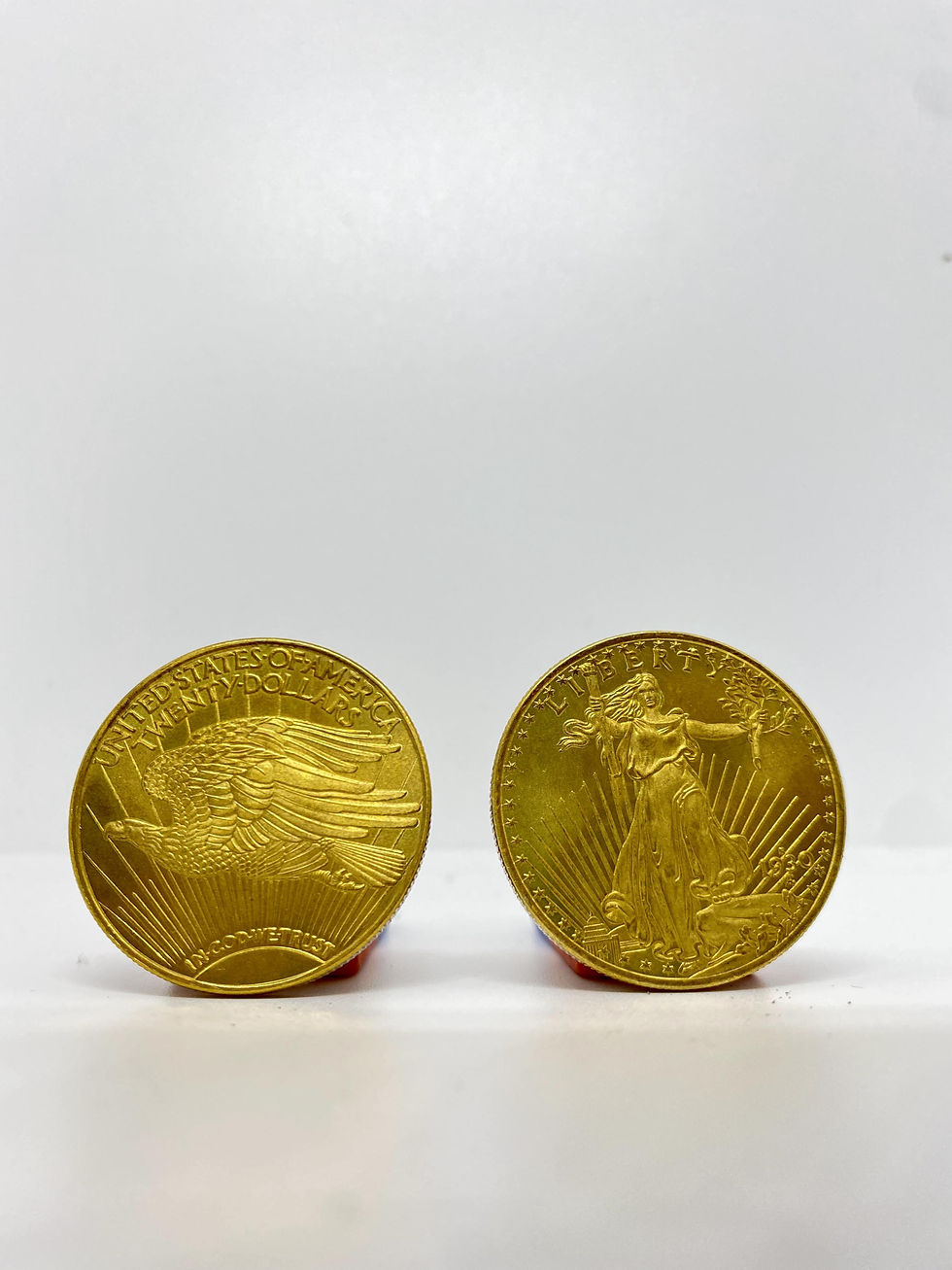
Amazing replica gold plated coin of a 1849 $5 Oregon Exchange Co. Five Dollar K-1, R.6. Since the earlier commerce of the region had been based on barter, governmental scrip, wheat, and merchants' orders, Oregon quickly realized the opportunity to improve its monetary situation represented by the discovery of gold in California. News of the growing Gold Rush first reached Oregon on July 31, 1848 when the schooner Honolulu arrived from Yerba Buena (San Francisco), took on a cargo of knives, spades, picks, pans, and flours, and departed for the "hills of California." The news from California was confirmed on August 9, and within a short space of time two-thirds of Oregon's male population had departed for the gold fields. The amount of gold dust brought back to Oregon had already reached $400,000 by the winter of 1849. In order to make this gold more readily acceptable, the provisional government of Oregon drafted a Bill that called for the creation of a territorial mint at Oregon City. These plans, however, were frustrated when Oregon became a full-fledged territory of the United States and General Joseph Lane arrived as territorial governor on March 2, 1849. The provisional government's proposed coinage Bill was nullified on the grounds on unconstitutionality, but there was no getting around the fact that something had to be done to regulate the circulation of gold in the Oregon Territory. Taking matters into their own hands, William K. Kilborn, Theophilus Magruder, James Taylor, George Abernathy, William H. Wilson, William H. Rector, John Gill Campbell, and Noyes Smith founded the Oregon Exchange Company shortly after the arrival of General Lane. They decided to produced Five and Ten Dollar gold coins with or without government approval at a two-story building at the corner of 5th and Water Streets in Oregon City. The first coins issued by the Oregon Exchange Company were Five Dollar pieces that reached circulation in late March 1849. The design is credited to John Gill Campbell, while the dies were engraved by Hamilton Campbell and William H. Rector. The obverse die contains two engraving errors: O. T. for Oregon Territory is reversed and reads T. O., and Campbell's initial C along the upper border reads G. A total of 6,000 Five Dollar coins were issued, and they, along with the Ten Dollar pieces, helped to tide Oregon's economy over until the establishment of the United States Mint at San Francisco. This is only the second 1849 Oregon Exchange Company Five Dollar that we have offered in one of our Signature Sales over the last ten years. The other was an XF45 PCGS coin that appeared as lot 7612 in our 1993 Baltimore ANA Signature Sale. The present XF representative is green-gold in color with a smattering of light and moderate abrasions. There are really no individually distracting blemishes, although a small void in the reverse field above the N in NATIVE is noted as a pedigree marker. The otherwise bold definition wanes slightly at the lower right obverse border and in the corresponding area on the reverse, but the beaver's fur is quite well defined. A very popular type as this is the only Oregon Gold Rush variety that is reasonably available and within financial reach of most collectors. It is also much scarcer than first believed with only a couple of dozen or so known in all grades. Listed on page 300 of the current Guide Book.